| Authors | |
|---|---|
| Publisher | |
| Series | |
| Language | |
| Translator | DHARMA REALM BUDDHIST UNIVERSITY INTERNATIONAL INSTITUTE FOR THE TRANSLATION OF BUDDHIST TEXTS |
| Publication Year | Jan 1981 |
| Pages | 250 |
| Table of Contents | The outline for volume five appears on the following pages. Significant sections of the text are indicated in bold type. The outline for the entire sutra is found as an appendix in volume one. I3 The Buddha ties a strip of cloth to explain the principle. J1 Ananda explains his question and asks for instruction. J2 The Thus Come One’s clever explanation. K1 He cleverly sets up an analogy. L1 The original cloth is one strip. L2 He ties it in six knots. K2 He answers two questions. L1 The answer that WHEN THE SIX ARE UNTIED, THE ONE IS GONE. M1 By the analogy he shows that one starts with something that is the same and turns it into something different. M2 By the analogy he shows that if one gets rid of what is different, one can return to what is the same. L2 The answer that UNTYING THE KNOTS IS DONE IN SEQUENCE. M1 He explains the sequence of the knots. N1 He accords with sequence in tying the knots. N2 He uses an analogy to explain further. N3 To oppose the sequence is connected with the analogy. M2 He shows that the untying is done in sequence. N1 First he teaches him the technique of untying. O1 Ananda seeks to untie the knots of weariness. O2 The Thus Come One uses a clever analogy to show them. O3 He tells him that he should not erroneously accept or believe what was spoken. O4 If he selects an organ and unties the knot, then he will certainly be certified. N2 Then he shows that the untying is done in sequence. O1 He first questions him to lead him to awakening. O2 He uses that awakening to further unite with understanding. I4 THE PROFOUND TRANSMISSION OF SELECTING THE ORGAN. J1 Ananda traces his enlightenment and makes grateful obeisance. J2 He asks for instruction in the perfect penetration of the organ. K1 He has not yet penetrated the organ. K2 He is fortunate to meet the Thus Come One. K3 He hopes the Buddha will make the profound transmission. J3 THE BUDDHA INSTRUCTS ALL THE SAGES TO SPEAK K1 The Buddha asks all the sages. K2 The assembly tells their former causes. L1 The sages speak in general. M1 PERFECT PENETRATION THROUGH THE SIX DEFILING OBJECTS. N1 Ajnatakaundinya: the object of sound. N2 Upanishad: the object of form. N3 Fragrance Adorned: the object of smells. N4 Physician King: the object of taste. N5 Bhadrapala: the object of touch. N6 Kashyapa: the object of dharmas. M2 PERFECT PENETRATION THROUGH THE FIVE ORGANS. N1 Aniruddha: the eye organ. N2 Kshudrapanthaka: the nose organ. N3 Gavampati: the tongue organ. N4 Pilindavatsa: the body organ. N5 “Born into Emptiness”: the mind organ. M3 PERFECT PENETRATION THROUGH THE SIX CONSCIOUSNESSES N1 Shariputra: the eye consciousness. N2 Universal Worthy: the ear consciousness. N3 Sundarananda: the nose consciousness. N4 Purnamaitreyaniputra: the tongue consciousness. N5 Upali: the body consciousness. N6 Mahamaudgalyayana: the mind consciousness. M4 PERFECT PENETRATION THROUGH THE SEVEN ELEMENTS N1 Uchchushma: the fire element. N2 Maintaining the Ground Bodhisattva: the earth element. N3 Moonlight Bodhisattva: the water element. N4 Vaidurya Bodhisattva: the wind element. N5 Treasury of Emptiness Bodhisattva: the emptiness element. N6 Maitreya Bodhisattva: the consciousness element. O1 First he tells about his experience at the time of a Buddha of antiquity. O2 That Buddha teaches him to cultivate the samadhi of consciousness-only. O3 Later on his samadhi accomplished, he received a prediction. O4 He concludes his answer by telling how he was certified to perfect penetration. N7 Great Strength Bodhisattva: the element of perception. O1 He tells how he was transmitted the Dharma by a Buddha of old. O2 He brings up an analogy to show the intertwining of the response and the Way. P1 First he uses the analogy of two people. P2 Then he uses the analogy of a mother and her child. P3 He connects it with the Dharma to show the profound benefit. P4 He recollects how he benefitted himself and benefitted others. P5 He concludes his answer by telling how he was certified to perfect penetration. L2 KUAN YIN BODHISATTVA EXPLAINS IN DETAIL M1 He explains how he received a prediction from a former Buddha. M2 He gradually unties the knot, cultivates, and is certified. M3 He explains how in accord with the substance, he gives rise to the function. N1 He lists two sources. N2 He explains in three parts. O1 THIRTY-TWO RESPONSE BODIES P1 He relies on the compassionate power. P2 He explains the wonderful responses one by one. Q1 He responds to the seeking of the sages. Q2 He responds to the seeking of the gods. R1 Heavenly Kings. R2 Heavenly ministers. Q3 He responds to the seeking of the human destiny. R1 Kings, ministers, citizens. R2 Sangha members. R3 Wives of officials. R4 Virgin youths. Q4 He responds to those who wish to leave the eight divisions. Q5 He responds to people who seek to be people. Q6 He responds to those non-humans who wish to leave their non-human state. P3 He concludes with the name and the reasons. O2 FOURTEEN FEARLESSNESSES P1 He relies on kindness. P2 He lists the fourteen fearlessnesses. Q1 Fearlessness in the eight difficulties. Q2 Fearlessness with the three poisons. Q3 Fearlessness for those with the two kinds of seeking. Q4 Fearlessness in those who hold the name. P3 Concludes with the name and shows the benefits. O3 Four Inconceivables P1 He bases himself on the comfort and power of perfect penetration. P2 The inconceivable identical embodiment of mantras. P3 The inconceivable embodiment of different mantras. P4 The inconceivable destruction of greed in response to those who seek. P5 The inconceivable offerings to Buddhas and aid to living beings. M4 He concludes his answer about accomplishing perfect penetration. K3 THE BUDDHA MANIFESTS PORTENTS IN RESPONSE. L1 He shows the general appearance of perfect penetration. L2 He shows the specific appearance of perfect penetration. J3 THE BUDDHA INSTRUCTS MANJUSHRI TO SELECT ONE. K1 The Thus Come One instructs him to select. L1 He first explains that all descriptions are equal. L2 His reason for asking him to select one. K2 MANJUSHRI RESPONDS WITH A VERSE. L1 He prepares to speak the verse. L2 He speaks the verse. M1 He brings the source up to introduce his selection. N1 He shows two sources. N2 He discusses production and extinction. N3 He makes clear there must be a selection. M2 He examines each door. N1 HE EXAMINES THE SIX DEFILING OBJECTS. N2 EXAMINING THE FIVE ORGANS. N3 EXAMINING THE SIX CONSCIOUSNESSES. N4 EXAMINING THE SEVEN ELEMENTS. M3 HE SELECTS ONLY THE EAR ORGAN. N1 He reveals the wonder of this Dharma door. O1 The ear organ is beneficial for those of this world to cultivate. O2 The Dharma is used by a superior person. P1 General praise of its benefit to self. P2 Broadly reveals its benefits to others. O3 Reveals that this Dharma is true and actual. P1 True and actual perfection. P2 True and actual penetration. P3 True and actual constancy. O4 He shows that this is the appropriate organ to cultivate. P1 He brings up the substance of the teaching in this land. P2 Makes clear that the sickness lies in following the sounds. N2 He explains in detail how to cultivate this skill. O1 He introduces the teaching of turning back the hearing. O2 He explains how with this Dharma one gradually transcends. O3 He brings up an analogy to relate to the Dharma just explained. O4 He concludes by telling that the cause and effect are ultimate. M4 HE URGES EVERYONE TO DILIGENTLY CULTIVATE AND CERTIFY. M5 He concludes his answer. M6 He seeks aid and generally concludes. H3 Based on the instruction the Great Assembly becomes enlightened and accomplishes entry. I1 Ananda and those like him become enlightened. I2 Matangi’s daughter and those like her accomplish entry. |
狀態:可借
📖 此為圖書館藏書,請至櫃台辦理借閱。
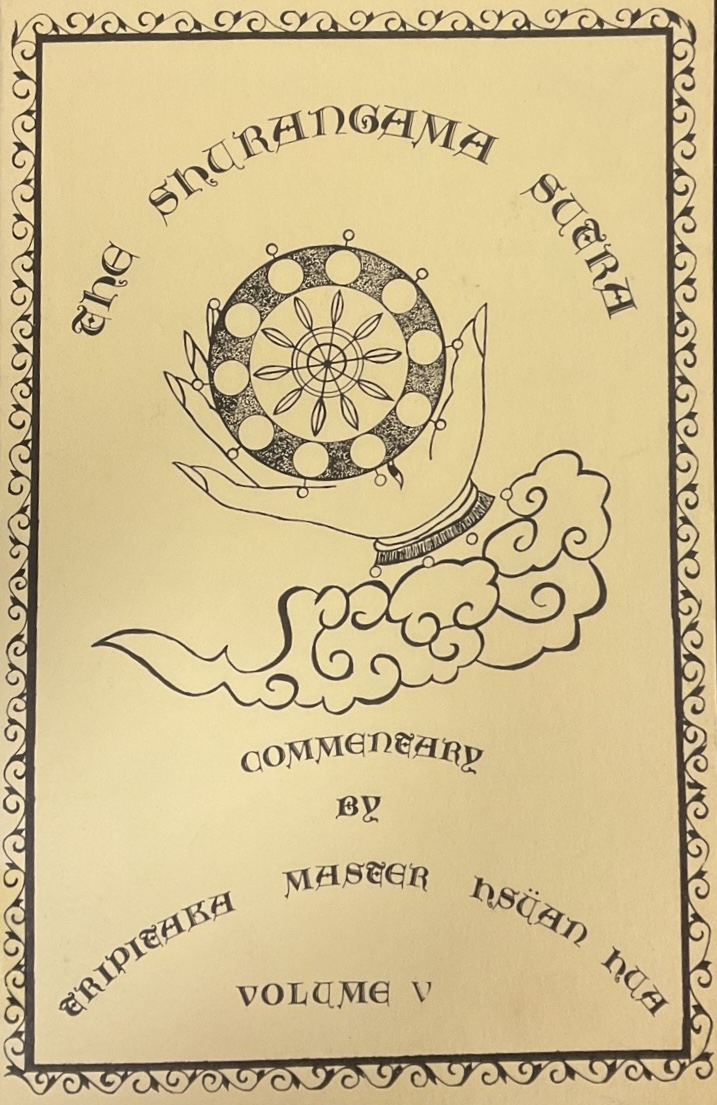
THE SHURANGAMA SUTRA
book ID :7210202701000502
Series:VOLUME V
The outline for volume five appears on the following pages. Significant sections of the text are indicated in bold type. The outline for the entire sutra is found as an appendix in volume one.
I3 The Buddha ties a strip of cloth to explain the principle.
J1 Ananda explains his question and asks for instruction.
J2 The Thus Come One’s clever explanation.
K1 He cleverly sets up an analogy.
L1 The original cloth is one strip.
L2 He ties it in six knots.
K2 He answers two questions.
L1 The answer that WHEN THE SIX ARE UNTIED, THE ONE IS GONE.
M1 By the analogy he shows that one starts with something that is the same and turns it into something different.
M2 By the analogy he shows that if one gets rid of what is different, one can return to what is the same.
L2 The answer that UNTYING THE KNOTS IS DONE IN SEQUENCE.
M1 He explains the sequence of the knots.
N1 He accords with sequence in tying the knots.
N2 He uses an analogy to explain further.
N3 To oppose the sequence is connected with the analogy.
M2 He shows that the untying is done in sequence.
N1 First he teaches him the technique of untying.
O1 Ananda seeks to untie the knots of weariness.
O2 The Thus Come One uses a clever analogy to show them.
O3 He tells him that he should not erroneously accept or believe what was spoken.
O4 If he selects an organ and unties the knot, then he will certainly be certified.
N2 Then he shows that the untying is done in sequence.
O1 He first questions him to lead him to awakening.
O2 He uses that awakening to further unite with understanding.
I4 THE PROFOUND TRANSMISSION OF SELECTING THE ORGAN.
J1 Ananda traces his enlightenment and makes grateful obeisance.
J2 He asks for instruction in the perfect penetration of the organ.
K1 He has not yet penetrated the organ.
K2 He is fortunate to meet the Thus Come One.
K3 He hopes the Buddha will make the profound transmission.
J3 THE BUDDHA INSTRUCTS ALL THE SAGES TO SPEAK
K1 The Buddha asks all the sages.
K2 The assembly tells their former causes.
L1 The sages speak in general.
M1 PERFECT PENETRATION THROUGH THE SIX DEFILING OBJECTS.
N1 Ajnatakaundinya: the object of sound.
N2 Upanishad: the object of form.
N3 Fragrance Adorned: the object of smells.
N4 Physician King: the object of taste.
N5 Bhadrapala: the object of touch.
N6 Kashyapa: the object of dharmas.
M2 PERFECT PENETRATION THROUGH THE FIVE ORGANS.
N1 Aniruddha: the eye organ.
N2 Kshudrapanthaka: the nose organ.
N3 Gavampati: the tongue organ.
N4 Pilindavatsa: the body organ.
N5 “Born into Emptiness”: the mind organ.
M3 PERFECT PENETRATION THROUGH THE SIX CONSCIOUSNESSES
N1 Shariputra: the eye consciousness.
N2 Universal Worthy: the ear consciousness.
N3 Sundarananda: the nose consciousness.
N4 Purnamaitreyaniputra: the tongue consciousness.
N5 Upali: the body consciousness.
N6 Mahamaudgalyayana: the mind consciousness.
M4 PERFECT PENETRATION THROUGH THE SEVEN ELEMENTS
N1 Uchchushma: the fire element.
N2 Maintaining the Ground Bodhisattva: the earth element.
N3 Moonlight Bodhisattva: the water element.
N4 Vaidurya Bodhisattva: the wind element.
N5 Treasury of Emptiness Bodhisattva: the emptiness element.
N6 Maitreya Bodhisattva: the consciousness element.
O1 First he tells about his experience at the time of a Buddha of antiquity.
O2 That Buddha teaches him to cultivate the samadhi of consciousness-only.
O3 Later on his samadhi accomplished, he received a prediction.
O4 He concludes his answer by telling how he was certified to perfect penetration.
N7 Great Strength Bodhisattva: the element of perception.
O1 He tells how he was transmitted the Dharma by a Buddha of old.
O2 He brings up an analogy to show the intertwining of the response and the Way.
P1 First he uses the analogy of two people.
P2 Then he uses the analogy of a mother and her child.
P3 He connects it with the Dharma to show the profound benefit.
P4 He recollects how he benefitted himself and benefitted others.
P5 He concludes his answer by telling how he was certified to perfect penetration.
L2 KUAN YIN BODHISATTVA EXPLAINS IN DETAIL
M1 He explains how he received a prediction from a former Buddha.
M2 He gradually unties the knot, cultivates, and is certified.
M3 He explains how in accord with the substance, he gives rise to the function.
N1 He lists two sources.
N2 He explains in three parts.
O1 THIRTY-TWO RESPONSE BODIES
P1 He relies on the compassionate power.
P2 He explains the wonderful responses one by one.
Q1 He responds to the seeking of the sages.
Q2 He responds to the seeking of the gods.
R1 Heavenly Kings.
R2 Heavenly ministers.
Q3 He responds to the seeking of the human destiny.
R1 Kings, ministers, citizens.
R2 Sangha members.
R3 Wives of officials.
R4 Virgin youths.
Q4 He responds to those who wish to leave the eight divisions.
Q5 He responds to people who seek to be people.
Q6 He responds to those non-humans who wish to leave their non-human state.
P3 He concludes with the name and the reasons.
O2 FOURTEEN FEARLESSNESSES
P1 He relies on kindness.
P2 He lists the fourteen fearlessnesses.
Q1 Fearlessness in the eight difficulties.
Q2 Fearlessness with the three poisons.
Q3 Fearlessness for those with the two kinds of seeking.
Q4 Fearlessness in those who hold the name.
P3 Concludes with the name and shows the benefits.
O3 Four Inconceivables
P1 He bases himself on the comfort and power of perfect penetration.
P2 The inconceivable identical embodiment of mantras.
P3 The inconceivable embodiment of different mantras.
P4 The inconceivable destruction of greed in response to those who seek.
P5 The inconceivable offerings to Buddhas and aid to living beings.
M4 He concludes his answer about accomplishing perfect penetration.
K3 THE BUDDHA MANIFESTS PORTENTS IN RESPONSE.
L1 He shows the general appearance of perfect penetration.
L2 He shows the specific appearance of perfect penetration.
J3 THE BUDDHA INSTRUCTS MANJUSHRI TO SELECT ONE.
K1 The Thus Come One instructs him to select.
L1 He first explains that all descriptions are equal.
L2 His reason for asking him to select one.
K2 MANJUSHRI RESPONDS WITH A VERSE.
L1 He prepares to speak the verse.
L2 He speaks the verse.
M1 He brings the source up to introduce his selection.
N1 He shows two sources.
N2 He discusses production and extinction.
N3 He makes clear there must be a selection.
M2 He examines each door.
N1 HE EXAMINES THE SIX DEFILING OBJECTS.
N2 EXAMINING THE FIVE ORGANS.
N3 EXAMINING THE SIX CONSCIOUSNESSES.
N4 EXAMINING THE SEVEN ELEMENTS.
M3 HE SELECTS ONLY THE EAR ORGAN.
N1 He reveals the wonder of this Dharma door.
O1 The ear organ is beneficial for those of this world to cultivate.
O2 The Dharma is used by a superior person.
P1 General praise of its benefit to self.
P2 Broadly reveals its benefits to others.
O3 Reveals that this Dharma is true and actual.
P1 True and actual perfection.
P2 True and actual penetration.
P3 True and actual constancy.
O4 He shows that this is the appropriate organ to cultivate.
P1 He brings up the substance of the teaching in this land.
P2 Makes clear that the sickness lies in following the sounds.
N2 He explains in detail how to cultivate this skill.
O1 He introduces the teaching of turning back the hearing.
O2 He explains how with this Dharma one gradually transcends.
O3 He brings up an analogy to relate to the Dharma just explained.
O4 He concludes by telling that the cause and effect are ultimate.
M4 HE URGES EVERYONE TO DILIGENTLY CULTIVATE AND CERTIFY.
M5 He concludes his answer.
M6 He seeks aid and generally concludes.
H3 Based on the instruction the Great Assembly becomes enlightened and accomplishes entry.
I1 Ananda and those like him become enlightened.
I2 Matangi’s daughter and those like her accomplish entry.